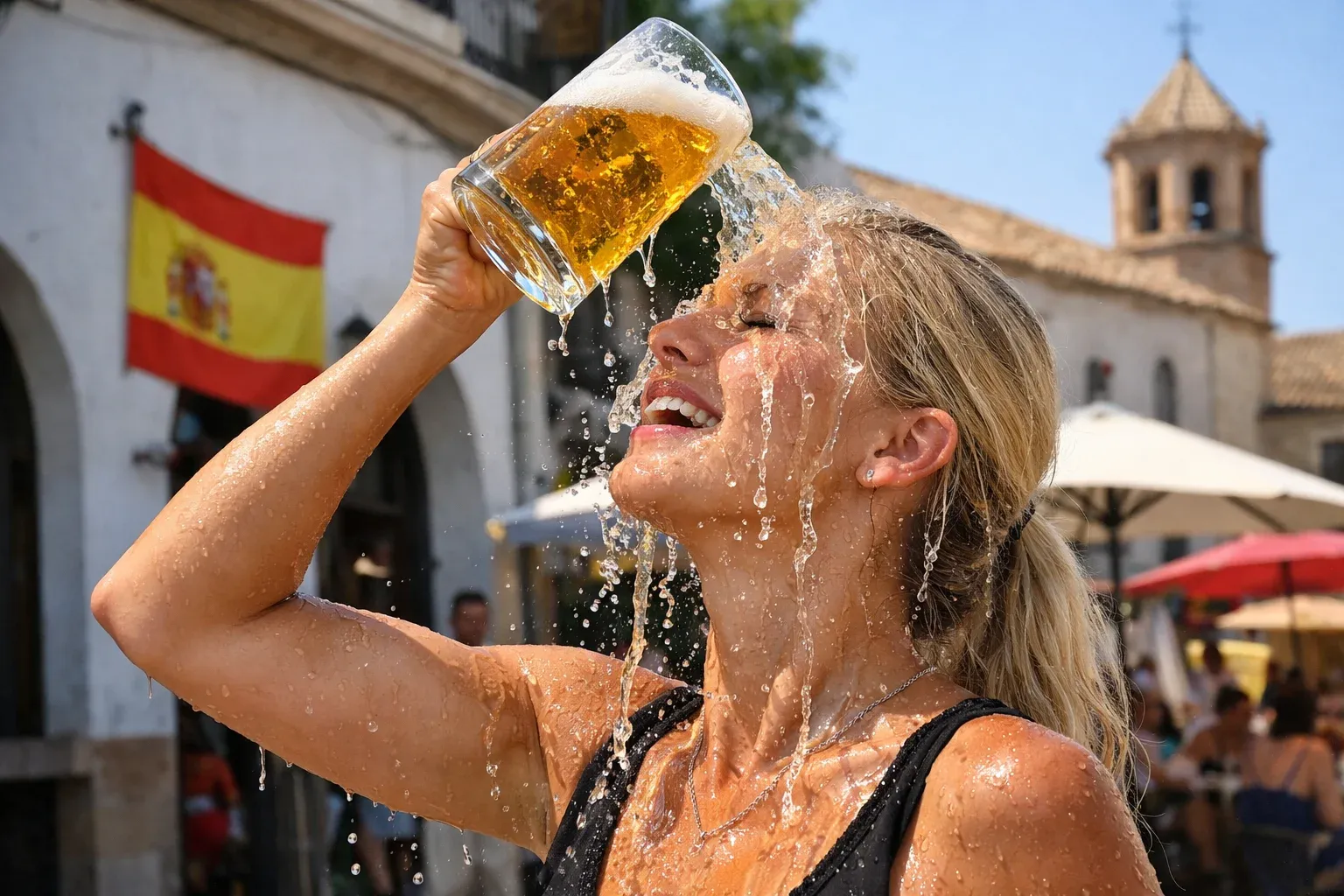
The Art of the Caña: How to Order Beer in Spain Without Embarrassing Yourself
Think ordering a beer in Spain is easy? Think again. From "thimble-sized" glasses to the secret rules of free tapas, here’s how to master the caña without looking like a total tourist.
Beer Sizes in Spain Explained — From Zurito to Jarra, Region by Region
Picture the scene. First week in Spain. It is 35 degrees. The shirt is sticking to places shirts should not stick. A cold beer sounds like the most reasonable idea any human has ever had.
The bar looks perfect. Small. Dark. A football scarf pinned behind the counter. Two old men arguing about something that sounds life-threatening but is probably about parking. The smell of olive oil and something fried and wonderful.
Deep breath. Walk up. Deliver the one phrase that every language app, every travel blog, and every well-meaning colleague has confirmed is correct:
"Una cerveza, por favor."
The bartender looks up. Not annoyed. Worse. Patient. The way a kindergarten teacher looks at a child who just called a rectangle "a long square."
"¿Pero de qué?"
Of what? What do you mean, of what? It is a bar. There is a tap. The tap has beer. The beer is cold. The request seems fairly self-explanatory. But the bartender is waiting. The two old men have paused their parking dispute. Everyone is waiting.
And in that silence, three truths arrive at once: Spanish is harder than Duolingo promised, this bar has rules nobody mentioned, and the shirt situation is getting worse.
The Glass That Started a Psychological Crisis
The bartender — because Spanish bartenders are fundamentally kind to confused foreigners — eventually pours something and puts it on the counter.
It is a caña. Roughly 200ml. Less than half a pint. It is, by any northern European measurement, the amount of beer that a normal glass spills on the way to the table.
The internal monologue is immediate:
"That's it? That's the beer? That is not a beer. That is a rumour of a beer. That is what a beer tells its friends about when describing a difficult childhood. I am supposed to pay for that? The man next to me got the same size and he looks — why does he look happy? He looks so happy. Why is he happy. It is an egg cup with foam."
Here is the twist: the man next to the counter is happy because he understands something that takes most foreigners about two weeks and four warm pints to learn.
The caña is small on purpose.
Spain has one bar for every 175 inhabitants. In a country where Seville hits 40°C while Galicia drowns in Atlantic rain on the same afternoon, a 200ml beer stays cold for exactly as long as it takes to drink. Then another one arrives. Also cold. Also perfect. Nobody nurses a warm half-litre of sadness like a tourist on a London pub bench in November.
And here is where the system turns genius: in cities like Granada, Jaén, and Almería, every caña comes with a free tapa. A plate of food. That nobody ordered. That just appears, like the bar felt sorry for your hunger and decided to handle it without making a scene.
(In Barcelona, the tapas are not free. The cañas are still cold. Nobody has solved everything.)
Price? Between €1.20 and €2.50. By the third round, the expat brain stops converting to pounds, dollars, or euros-per-litre and simply accepts that this country has figured out something the rest of Europe has not.
The Vocabulary That Proves Spain Is Actually Seventeen Countries
Caña — 200ml draft. The universal safe word. When the brain short-circuits, say this.
Zurito — Smaller than a caña. Basque Country only. Ordering one in Seville produces the same face a British person makes when someone puts milk in first.
Penalti — The exact same tiny pour, but in Aragón. Named "penalty" for reasons that remain unconfirmed. Current leading theory: because ordering one feels like committing a foul against beer itself.
Doble — In Madrid, about 330ml. In the Basque Country, it can arrive at nearly 700ml. That is not a regional variation. That is a completely different life decision. Ordering a doble without checking which city the bar is in is the beer equivalent of opening someone else's luggage at the airport and just hoping for the best.
Jarra — Either a mug, a large glass, or an entire pitcher for the table. Nobody knows which one until it arrives. There is a version of this where four friends order four jarras expecting glasses and receive four jugs. They do not leave that bar sober. They may not leave that bar at all.
Clara — Beer with lemon soda. Delicious. But in most of Spain, "clara" means beer with Fanta Limón. In Galicia, it often means beer with sparkling water. In Valencia, that version is called champú. Like shampoo. If someone accidentally washes their hair with it after five rounds, that is their problem and frankly an understandable mistake.
Cerveza sin — Alcohol-free beer. Zero stigma. Spain was doing this decades before "Dry January" became a personality trait elsewhere. Ordering one at a work lunch is completely normal. Nobody will stage an intervention.
For even more regional variations, every autonomous community has opinions. Strong ones. This is not a problem. This is a hobby.
The Unwritten Rules (Written Down Here for the First Time by Someone Who Learned Them Badly)
This is where the real comedy lives. Because knowing the vocabulary is one thing. Knowing how to behave at the bar is the part that gets foreigners into actual trouble.
The tap mystery. A newcomer walks into a Spanish bar, sees two taps, and thinks: "This place has limited options." A Spaniard walks into the same bar and thinks: "This place has beer." Most traditional bars pour two to four near-identical pale lagers. This is not a flaw. This is a public service. Nobody stands frozen in front of fourteen artisanal options performing a personality test through hops selection while the bartender silently considers early retirement.
The floor. This deserves its own moment. The floor of a busy Spanish bar is covered in used napkins, olive pits, shrimp tails, toothpicks, and the occasional mystery item. The first time a newcomer sees this, the instinct is strong: pick it up. Clean it. Alert someone. Fix this. The bar is clearly in crisis.
The bar is not in crisis. The bar is at peak performance. That floor is a scoreboard. The messier it is, the better the bar is doing. Fighting the urge to tidy is one of the great psychological adjustments of moving to Spain, right up there with accepting that tomorrow is a festivo and nobody told you.
The money wave. Do not wave money at a Spanish bartender. Do not tap the counter. Do not make frantic eye contact while holding a €20 note overhead like a bidder at an auction for hydration. Spanish bartenders are fast because the bar is busy — not because anyone is rushing them. The correct approach is calm eye contact and "cuando puedas" — "when you can." The person who waves money will be served last. Not out of rudeness. Out of justice.
The round ledger. Newcomers from rigid round-buying cultures (the British, especially) arrive expecting a system. "I buy, then you buy, then James buys." Spain does not work like this. Someone pays. Then someone else pays. There is no spreadsheet. But — and this is critical — do not confuse loose with stupid. Spaniards keep an invisible, long-term mental ledger with the accuracy of a Swiss bank and the patience of a glacier. The person who vanishes when the bill arrives three times in a row will not be confronted. That would be rude. They will simply stop being invited. Quietly. Permanently. They will find out at a birthday party they did not hear about. That is the Spanish judicial system for cheapskates, and there is no appeals process.
The Craft Thing (Fast, Because the Neighbourhood Bar Is Not Threatened)
Spain went from about 40 breweries in 2008 to well over 500. The craft market is growing at over 8% per year. In 2025, Hijos de Rivera — the family behind Estrella Galicia — took a majority stake in Basqueland Brewing. The scene is real.
But the corner bar with one tap, a plate of olives, and a bartender who has been pouring cañas since before craft beer had a name? Still there. Still €1.50. Still serving food that nobody ordered and everybody needed.
The only visible 2026 upgrade: a contactless card reader sitting on the counter. It gets used about half the time. The other half, it is cash, a nod, and a glass that appears before the payment method is even discussed. Nobody has introduced a QR code for the free olives. Yet.
What Is Actually Going to Happen (A Prophecy)
For anyone reading this from London, New York, Berlin, or wherever the suitcase is being packed — the empadronamiento guide will not prepare anyone for this part.
Week one: order "una cerveza" and get a patient look. Feel confused. Receive a glass smaller than expected. Question the entire country's approach to liquid volume. Convert the price to home currency. Stare at the floor. Wonder if someone should call somebody.
Week three: order "una caña" and feel a small, private thrill of competence. Receive a tapa without asking. Do not question it. Eat the tapa. Order another caña. Eat that tapa too. Start to suspect this country might be onto something.
Week six: order "ponme una caña" without thinking. The bartender does not pause. There is no loaded silence. No kindergarten teacher look. Just a cold glass, a clean pour, and a small plate of something fried appearing out of nowhere — not unlike the unspoken rules of the Spanish greeting that also eventually stop being confusing and start being nice.
Week ten: accidentally order a doble in the Basque Country. Receive a glass the size of a small aquarium. Look at it. Look at the bartender. Look at the glass again. Drink it anyway. Earn the quiet respect of the two old men who, it turns out, were never really arguing about parking. They were arguing about which bar has the best croquetas. They have been arguing about this for fourteen years. They will never agree. And somehow, that is the most comforting thing about Spain.
The practical stuff — what to order where, a printable regional cheat sheet, and every meaning of "clara" across seventeen autonomous communities — lives inside the Spangolita members' area. Because some maps are worth having before the first round arrives.
The 2026 Solar Eclipse in Northern Spain: How to Accidentally Watch the Wrong Sky in the Basque Country
The ultimate guide to the August 12, 2026 Total Solar Eclipse in Northern Spain. Don’t miss totality: find the best viewing spots in Vitoria and Bilbao, avoid the '99% trap' in San Sebastián, and get the expert weather tips you need for a perfect eclipse in the Basque Country.
The TIE Card in Spain (2026): The 30-Day Deadline Nobody Explains Until It's Too Late
Visa in hand? Your 30-day countdown to get the TIE card has already started. Don’t let a missing appointment or a wrong form freeze your life in Spain. Here is the exact, step-by-step sequence to securing your residency in 2026 without the stress.
Spain's Real Estate Wild West Is Over: Why Not Anyone Can Sell You a House in 2026
The 'lemonade stand' era of selling Spanish property is over. As of 2026, new laws in Andalusia, Valencia, and Catalonia make registration mandatory. Don't let a 'Dave' handle your deposit—learn the new legal requirements and avoid massive fines in Spain's new real estate era.
Barcelona in Three Days — A Practical City Guide (2026 Edition)
Three days in Barcelona, 2026. Tickets booked, shoes on, and coffee in hand—let’s survive Gaudí, crowded mosaics, and the occasional lost tourist. Wander Gothic alleys, stare at dragon benches, eat tapas by counting toothpicks, and actually feel the city—without pretending you can see everything.
Cl@ve and Digital Certificate in Spain 2026: The Setup Mistake That Blocks Every Future Appointment
Most expats register for Cl@ve before getting their Digital Certificate and get stuck. This 2026 guide shows the correct sequence, common NIE mistakes to avoid, and how to set up both systems properly in one afternoon.
The Spanish Health Card: Why a Social Security Number Is Not Enough
Having a Social Security number in Spain doesn’t automatically mean you can see a doctor. This article breaks down the overlooked administrative step that blocks healthcare access—and how to avoid wasting time at the health center.
You arrive ready to work. Your calendar is full. Your motivation is high. And then Spain casually reminds you it’s a holiday. Again. A funny, honest look at how Spanish festivos slowly break the foreign work brain.
Join 1k+ Readers — Get Premium Stories and Insights
Get our best stories, insights, and trending topics delivered straight to your inbox. Join thousands of readers who never miss what matters.
The Art of the Caña: How to Order Beer in Spain Without Embarrassing Yourself
Think ordering a beer in Spain is easy? Think again. From "thimble-sized" glasses to the secret rules of free tapas, here’s how to master the caña without looking like a total tourist.
The 2026 Solar Eclipse in Northern Spain: How to Accidentally Watch the Wrong Sky in the Basque Country
The ultimate guide to the August 12, 2026 Total Solar Eclipse in Northern Spain. Don’t miss totality: find the best viewing spots in Vitoria and Bilbao, avoid the '99% trap' in San Sebastián, and get the expert weather tips you need for a perfect eclipse in the Basque Country.
The TIE Card in Spain (2026): The 30-Day Deadline Nobody Explains Until It's Too Late
Visa in hand? Your 30-day countdown to get the TIE card has already started. Don’t let a missing appointment or a wrong form freeze your life in Spain. Here is the exact, step-by-step sequence to securing your residency in 2026 without the stress.